Mahjong questions, answered
American mahjong rules, answered simply.
Short, clear answers to the questions people search most when they’re learning American mahjong. Rules follow the National Mah Jongg League. Some tables add house rules, so check with your group.
0146 rules questions answered
02National Mah Jongg League rules
03Free printable PDF
Jokers
Joker rules.
How many Jokers are in American mahjong?
8. They’re the most powerful tiles in the set, so treat them like gold.
Can you use a Joker in a pair?
No. Never. A Joker only works in a group of 3 or more tiles that are all the same, like a pung (3), kong (4) or quint (5). A pair is only 2, so it has to be 2 real tiles.
Can you use a Joker for NEWS, the year, or a run like 2 3 4?
No. In N E W S, 2 0 2 6 or 2 3 4, every tile is different. Each one is a single, and Jokers can’t be singles. Think of it this way: a Joker can only pretend to be a tile that already has twins sitting next to it.
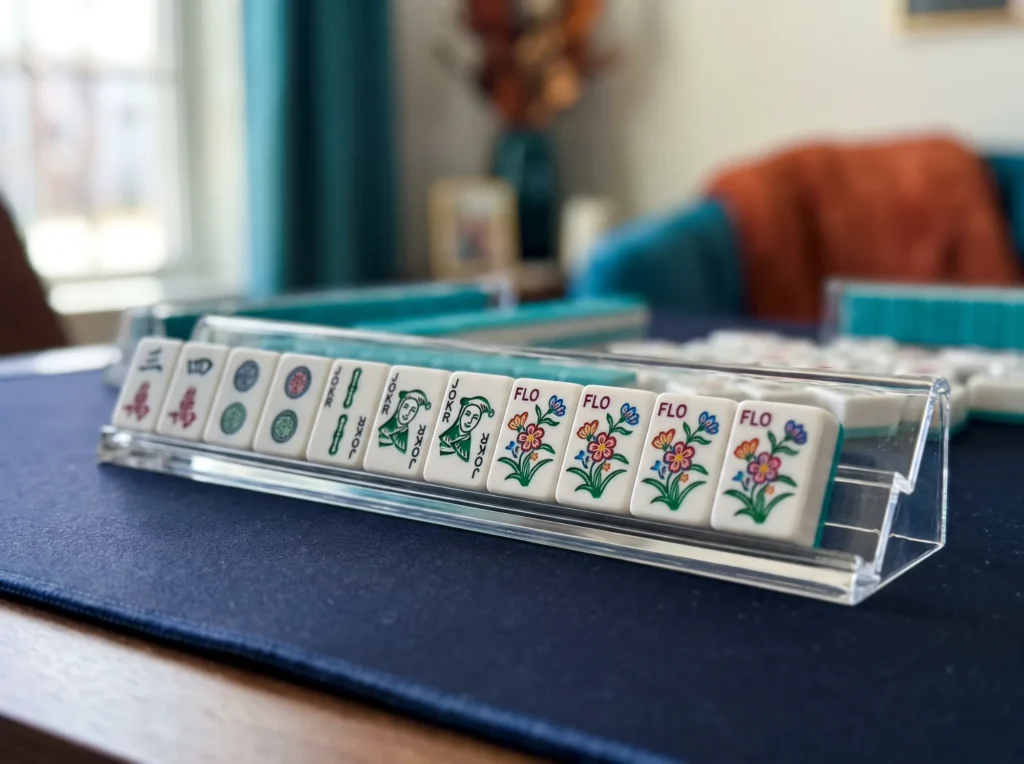
Can you use Jokers with Flowers?
Yes, if the Flowers are in a group of 3 or more. A pung of Flowers can be 2 Flowers and 1 Joker. A pair of Flowers can’t use a Joker.
Can you use Jokers with Winds or Dragons?
Yes, same rule. NNN or a kong of Red Dragons can use Jokers. A single N or a pair of Dragons can’t.
Can you pick up a Joker someone threw away?
No. Once a Joker is in the discards, nobody can take it. It’s out of the game.
Can you throw away a Joker?
Yes, you’re allowed to. It’s almost always a bad idea, though. Some players do it late in a game so they don’t hand someone else a winning tile.
How do you swap for a Joker?
On your turn, after you draw, look at the groups showing on everyone’s racks. If a group has a Joker and you have the real tile it stands for, hand over your real tile and take the Joker. You can even do it with your own groups. You can’t take a Joker from tiles nobody can see.
Can you use Jokers in a concealed (C) hand?
Yes, in groups of 3 or more. Concealed only means you can’t call tiles for it, except your winning tile.
Can your whole hand be Jokers?
Your pungs and kongs can be all Jokers. But every line has pairs or singles too, and those must be real tiles. So no, not the whole hand.
Calling tiles
Calling tiles.
What does “call” mean in mahjong?
When someone throws a tile you need, you say “Call!” (or the tile’s name) and take it. Then you show that group on top of your rack. That shown group is called an exposure.
Can you call a tile to make a pair?
Only if it’s the very last tile you need to win. Otherwise, pairs have to come from the wall. Easy way to remember: draw ’em, don’t call ’em.
Can you call a single tile, like for NEWS or a run?
Same answer. Only if it wins the game for you.
When can you call a discard?
Right after it’s thrown. You have until the next player puts her new tile on her rack. Once it’s racked, that discard is gone for good. So speak up fast.
I called a tile, then changed my mind. Is that okay?
If you haven’t touched the tile or shown any of your tiles, you can say “never mind.” (Yes, this is where “Pause. Nevermind.” comes from.) Once you’ve touched it, you have to use it.
What is a concealed hand in mahjong?
A line with a C at the end. You build the whole thing yourself from the wall. The only tile you can call is your winning one.
At the table
Weird things that happen at the table.
Two people call the same tile. Who gets it?
If one person needs it to win and the other doesn’t, the winner gets it. Winning beats everything. If both need it to win, or both just want it for a group, it goes to the player whose turn comes up first after the person who threw it.
What happens if you call mahjong by mistake?
If you haven’t shown your tiles yet, just say “Oops, my mistake,” and the game keeps going. If you already laid your tiles down, your hand is dead, and the other players keep playing. If someone else threw in their tiles because they believed you, the game usually ends. Ask your group what they do.
What is a dead hand in mahjong?
A hand that can’t win anymore. Maybe you have the wrong number of tiles, or you showed a group that doesn’t fit any line on the card. Anyone can point it out.
My hand is dead. What do I do?
Stop drawing and stop throwing. Keep your tiles on your rack and sit tight while everyone else finishes. Others may still swap Jokers out of the groups you showed. It happens to everybody. Shake it off.
What if I have too many or too few tiles?
Your hand is dead. Count your tiles often. Before your turn you should have 13. After you draw, 14.
Nobody won and the tiles ran out. Now what?
That’s a wall game. Nobody wins. Mix the tiles and start the next game.
Someone said the wrong name when she threw a tile. Now what?
Fix it out loud right away. If another player already called it because of the wrong name, your table’s house rules decide what happens. Saying every discard clearly saves a lot of trouble.
The Charleston
The Charleston.
What is the Charleston in mahjong?
A tile swap before the game starts. Everyone passes 3 tiles: Right, Over, Left. Then you can do it again: Left, Over, Right. Remember it as ROLLOR.
Do you have to do the second Charleston?
No. Any player can stop it before it starts. But once you start the second Left, you finish all three passes.
What is a blind pass, and when can you do it?
Sometimes you don’t want to give up any of your own tiles. On the first Left and the last Right, you can pass along tiles you just got without looking at them. You still pass 3 total.
Can you pass a Joker in the Charleston?
No. Jokers never get passed in the Charleston or the courtesy pass.
What is the courtesy pass?
A last, optional swap with the player across from you. You each say how many you want to trade, 0 to 3, and you both trade the smaller number.
Which tiles should you keep during the Charleston?
Jokers (you can’t pass them anyway), Flowers, pairs, pungs, and 5s. A 5 fits odd hands, runs and like numbers. Pass tiles that don’t match anything else you have.
Dragons, Flowers and the Soap
Dragons, Flowers and the Soap.
Which Dragon goes with which suit?
Green goes with Bams. Red goes with Craks. White (the Soap) goes with Dots. Rhyme: Crak dragons are red, Bam dragons are green, Soap goes with bubbles and Dots come out clean.
What is the Soap in mahjong?
The White Dragon. It looks like a plain bar of soap. In the year lines (2026) it also plays the 0.
How many Flowers are in a mahjong set?
8. Any Flower matches any other Flower, even if the pictures are different.
Tiles and setup
Tiles and setup.
How many tiles are in an American mahjong set?
152. That’s 108 suit tiles (Bams, Craks and Dots, 1 to 9, four of each), 16 Winds, 12 Dragons, 8 Flowers and 8 Jokers.
How many tiles do you start with in mahjong?
13. East, the dealer, gets 14 and throws first.
How do you break the wall?
East rolls the dice, counts that many stacks along her wall from right to left, and splits it there. That’s where the dealing starts.
How do you deal mahjong tiles?
Take 4 tiles at a time, going to the right, until everyone has 12. Then East takes 2 more and everyone else takes 1. When one wall runs out, the player on the left pushes her wall out to keep going.
Can 2 or 3 people play American mahjong?
Yes, with a few changes, but 4 is the real game. We cover the changes in class.
Reading the card and winning
Reading the card and winning.
How do you read the mahjong card?
Each line is one winning hand. Count the tiles in each group: 2 is a pair, 3 is a pung, 4 is a kong. The colors show suits. Same color means same suit, and a new color means a new suit. You choose which suit gets which color. X at the end means you can call tiles. C means concealed.
What are “like numbers”?
One number used over and over, like all 7s. Pick any number from 1 to 9. The colors on the card still tell you how many suits to use.
What is a pung? A kong?
A pung is 3 of the same tile. A kong is 4. A quint is 5, and you’ll need a Joker for it, since there are only 4 of each tile.
How do you win at mahjong?
Get 14 tiles that match one line on the card exactly. Then say “Mahjong!” and lay your tiles down for everyone to check.
What’s the easiest mahjong hand to win?
The one your tiles already like. Hold your card by your rack. If 6 or more of your tiles fit one line, that’s a good place to start.
Learning the game
Before you learn.
Is mahjong hard to learn?
Not as hard as it looks. The card is the tricky part, and once someone walks you through it, it clicks. You’ll play real hands in your very first lesson.
What’s the difference between American and Chinese mahjong?
American mahjong uses a yearly card from the National Mah Jongg League, plus Jokers and the Charleston. Chinese mahjong has no card and no Jokers, and the winning hands are built differently. My lessons teach American mahjong.
Do you need a new mahjong card every year?
Yes. The National Mah Jongg League puts out a new card each year, and the hands change. Mahj 101 students get the 2026 card with their lesson.
An independent teaching aid from One Away Mahj. Not made by or affiliated with the National Mah Jongg League. Buy the official card each year to play.
Ready to play
Rather learn it at the table?
Mahj 101 covers all of this with real tiles in your hands. $75 per person, and your 2026 card is included.